Can It Be Built the Way It's Drawn?
The drawings passed plan review. The pedestal met code. Every sheet was internally consistent. The problem was a different question, and nobody had asked it out loud yet: can it be built the way it's drawn?
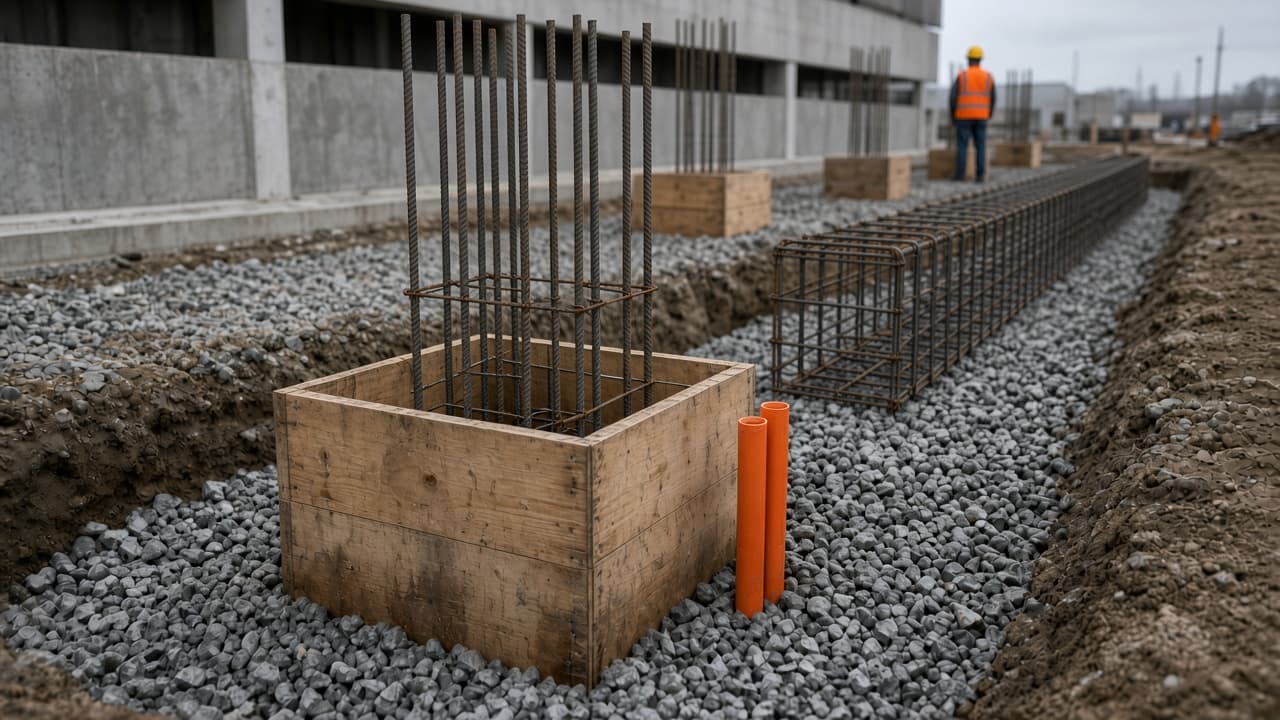
Picture a typical week fourteen.
The rebar shop drawings come back from the detailer. On the structural set, the column pedestal looked tidy: a clean square on the foundation plan, a typical detail on S-501, a note that says "see schedule." On the shop drawings, the pedestal has grown. Once someone actually fit the anchor bolts, the lap splices, the hooks and the clear cover into it, the concrete had to get bigger. Now the pedestal clips the edge of a grade beam. Two underground conduits drawn on the electrical set run straight through where it sits. The equipment pad that was supposed to land next to it doesn't fit anymore.
Nobody made a careless mistake. The drawings passed plan review. The pedestal met code. Every sheet was internally consistent. The problem was a different question, and nobody had asked it out loud yet: can it be built the way it's drawn?
That question has a name, constructability. It's one of the oldest ideas in the industry, and it's still one of the first things cut when a schedule gets tight.
What still makes sense is checking a design against the code. What no longer makes sense, in this era, is treating "it passed review" as if it meant "it can be built."
Code is a rulebook. Constructability is a judgment.
Code compliance and constructability get lumped together as "review," but they're very different kinds of work.
Code compliance is hard, but it's explicit. There's a book, a section number and a threshold. A stair either meets the riser limit or it doesn't, and a corridor is either wide enough or it isn't. That is why, when researchers surveyed early efforts to automate design checking, they found that almost all of them had targeted building code and accessibility criteria (Eastman et al., 2009). Rules written as rules are the natural place to start.
Constructability isn't written down that way. It lives in the space between the rules: whether a crew can get a tool into the space, whether the sequence works, whether two systems that are each correct on their own sheets can occupy the same six inches of ceiling. Researchers have called the constructability of a design a "subjective scale" that depends on a number of interdependent, project-related factors (Arditi et al., 2002). One attempt to build a quantitative constructability model for U.S. commercial buildings started from 79 separate attributes drawn from the literature (Zolfagharian & Irizarry, 2017). That isn't a checklist anyone runs from memory at 6 p.m. the night before a submission.
So the code check gets done, because it has to, because someone with a stamp signs for it, and because the permit depends on it. The constructability check gets done when there's time. There is rarely time.
Checking against the code still makes sense, and nobody should skip it. What no longer makes sense is letting the check that's easiest to define stand in for the one that's hardest.
Where the gap shows up
When constructability isn't reviewed on the drawings, it doesn't go away. It gets reviewed later by someone else, at a worse price.
It shows up first in shop drawings, when a detailer or fabricator has to turn intent into dimensions and finds that the parts don't fit. Then it shows up in RFIs, when the field asks the design team to resolve what the documents left open. And sometimes it ends in a change order, when the answer moves money or time.
The industry has measured parts of this. A 2014 industry survey of owners, architects and contractors asked how often specific kinds of design errors and omissions occur. "Constructibility issues of proposed design solutions" were rated as occurring frequently or very frequently by 55% of contractors, compared with 12% of architects and 29% of owners. The same split appeared elsewhere: 81% of contractors saw frequent lack of coordination among disciplines in contract documents, compared with 27% of architects (McGraw Hill Construction, 2014).
Read that gap generously. It doesn't mean architects aren't careful. It means the people who design a thing and the people who build it look at the same set from different chairs. The builder's chair is where constructability problems become visible, and in a typical delivery sequence, the builder sits down late.
The RFI data shows what "late" costs. An analysis of more than 1,300 projects found an average of 796 RFIs per project, with a median reply time of 9.7 days and an estimated $1,080 to review and answer each one (Hughes et al., 2013). In one study the report cites, "constructability issues" (difficulty building an item as detailed or designed) was one of 14 RFI categories (Hughes et al., 2013). Every one of those questions is a constructability review happening on the clock, one item at a time, while a crew waits.
Some late discovery still makes sense. No set is perfect, and some conditions only show up in the field. What no longer makes sense is relying on shop drawings and RFIs as the main place where buildability gets checked.
What the research said forty years ago
None of this is new. In 1986, the Construction Industry Institute published a primer whose definition of constructability is still widely quoted: "the optimum use of construction knowledge and experience in planning, design, procurement, and field operations to achieve overall project objectives." Its message to executives was blunt: build construction considerations into every phase, from feasibility and conceptual planning through design and procurement. It reported paybacks from constructability programs ranging up to fifteen to one (Construction Industry Institute [CII], 1986).
The RFI study arrived at the same point from the other end of the job. Among the RFI-prevention practices it compiled from AIA best-practice guidance was having the construction manager perform a constructability review before setting the construction budget, "to see that the design can be implemented" (Hughes et al., 2013).
So the industry has known for decades what to do. It hasn't been able to do it consistently, because a real constructability review takes scarce time from scarce people. It takes someone who has stood next to the pour reading the set across disciplines, against the specs and against how the thing actually goes together. Those people are booked. When the schedule compresses, the review compresses with it, or quietly becomes "we'll catch it in coordination."
What still makes sense, and what no longer does
It helps to separate the practices worth keeping from the habits that have simply outlived their reasons.
Still makes sense:
- 01Design intent comes first. The architect and engineer own what the building is supposed to be.
- 02Experienced builders' judgment is the final word on sequence, means and methods.
- 03Code review is non-negotiable and should stay rigorous.
- 04Some issues will always surface in the field, and teams need a good RFI process for them.
No longer makes sense:
- 01Treating a clean plan review as evidence that a set is buildable.
- 02Waiting for the detailer's shop drawings to be the first close cross-discipline read of a connection, a pedestal or a penetration.
- 03Skipping the constructability pass whenever the schedule is tight, which is exactly when it matters most.
- 04Accepting that reading a several-hundred-sheet set for buildability can only happen as fast as one senior person can turn pages.
That last point is the one that's changing. For most of the industry's history, the review was scarce because the reading was scarce. The judgment was never the bottleneck; the hours spent finding the places that needed judgment were. In this era, it's increasingly reasonable to expect the finding to happen earlier and faster, so the scarce people can spend their hours deciding.
Why it matters to everyone at the table
Constructability isn't only a contractor's concern. Each party pays for it differently.
- 01Cities and plan reviewers approve sets that meet code and still see them come back as revisions, deferred submittals and field changes. A buildable set is an easier set to inspect.
- 02Architects and engineers carry the RFI load and the reputational cost of "the drawings didn't work," even when the issue was a seam between disciplines.
- 03Developers and owners feel it as contingency drawn down, change orders and schedule slip, usually after the budget is already locked.
- 04General contractors absorb it at buyout and in the field, where every unresolved question costs crew time.
- 05Planning firms set the early massing and site moves that determine how hard everything downstream will be to build.
Each of them benefits when the question "can it be built?" is asked while the design is still easy to change, rather than once steel is on order.
Looking earlier
The leverage isn't a better RFI log. It's earlier.
When a set gets a serious buildability read before it goes out, meaning across disciplines, against the details and with an eye on how the parts actually go together, the conversation changes. The pedestal grows on paper instead of on the shop drawings. The conduit moves before anyone ties rebar. The RFI never needs to be written.
That's the work we care about at AutoSitu: helping teams surface those questions in the drawings early, so the experienced people on the project can spend their time on judgment instead of searching.
Checking against the code still makes sense. Discovering at shop drawings that the design can't be built as drawn no longer has to be normal, not in this era.
The best time to ask whether it can be built the way it's drawn is while it's still only drawn.
References
Arditi, D., Elhassan, A., & Toklu, Y. C. (2002). Constructability analysis in the design firm. Journal of Construction Engineering and Management, 128(2), 117–126. https://doi.org/10.1061/(ASCE)0733-9364(2002)128:2(117)
Construction Industry Institute. (1986). Constructability: A primer (Publication RS3-1). https://www.construction-institute.org/constructability-a-primer
Eastman, C., Lee, J.-M., Jeong, Y.-S., & Lee, J.-K. (2009). Automatic rule-based checking of building designs. Automation in Construction, 18(8), 1011–1033. https://doi.org/10.1016/j.autcon.2009.07.002
Hughes, N., Nutter, C. L., Wells, M., & Zack, J. G., Jr. (2013, April). Impact & control of RFIs on construction projects. Navigant Construction Forum. https://www.cmaanet.org/sites/default/files/2018-04/NCF%20IMPACT%20%26%20CONTROL%20OF%20RFIs%20ON%20CONSTRUCTION%20PROJECTS.pdf
McGraw Hill Construction. (2014). Managing uncertainty and expectations in building design and construction (SmartMarket Report). https://dbia.org/wp-content/uploads/2018/05/Research-McGrawHill-Managing-Uncertainty-Expectations-2014.pdf
Zolfagharian, S., & Irizarry, J. (2017). Constructability assessment model for commercial building designs in the United States. Journal of Construction Engineering and Management, 143(8), 04017031. https://doi.org/10.1061/(ASCE)CO.1943-7862.0001323