The Preconstruction Meeting Is Too Late to Start Looking
Twenty people, coffee going cold, and the latest issue set opened for the first time at the head of the table. Forty-five minutes in, the agenda still says "kickoff" and the room is doing first-pass drawing discovery.
The Preconstruction Meeting Is Too Late to Start Looking
There's a conference room on most jobs that looks the same every time.
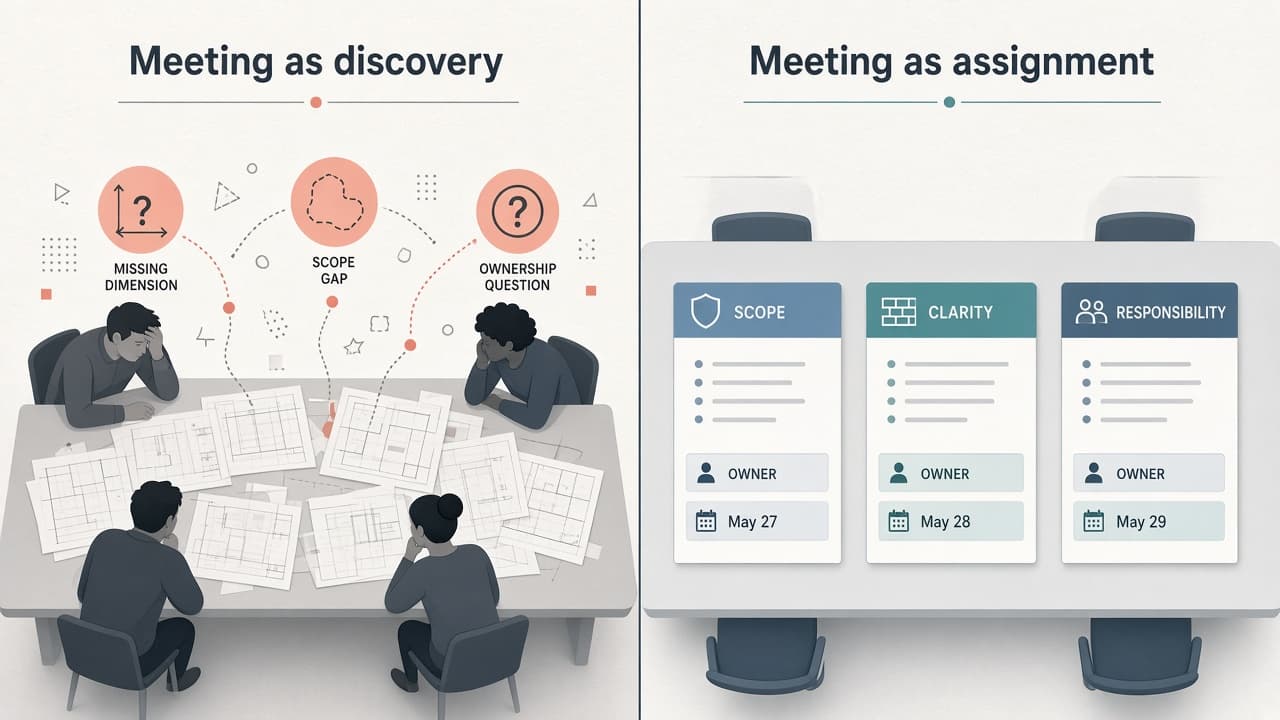
Twenty people. Coffee going cold. The latest issue set projected on the wall — or, more often, opened for the first time on a laptop at the head of the table. Someone flips to Sheet A1.01. Someone else asks about a dimension that isn't there. The MEP lead starts talking about a chase that doesn't line up with the structural grid. The drywall sub asks who owns firestopping at the rated openings. Forty-five minutes in, the agenda still says "kickoff," and the room is doing first-pass drawing discovery.
I've sat in enough of those rooms — and talked with enough precon leads and PMs afterward — that the pattern stopped sounding like bad luck. Nobody meant for the meeting to go that way. Everyone showed up ready to start. The set just hadn't been read closely enough — across disciplines, against the specs, against the permit comments — before the invitations went out.
What still makes sense is putting the right people in a room to decide. What no longer makes sense, in 2026, is using that room as the first place anyone really looks.
That is the quiet failure mode of preconstruction: we treat the kickoff as the place to find problems, when it should be the place to assign them.
What a good precon meeting actually decides
A useful precon meeting is not a scavenger hunt through the drawings. It is a decision session.
The best ones I've heard described leave with three things written down:
- 01A short list of open issues — already triaged, not discovered live.
- 02An owner for each one — design, owner, GC, or a named trade — not "the team."
- 03A cost or schedule flag where the answer will move money or the calendar.
Alignment is not consensus in the room. Alignment is a decision record that survives the room. When the notes die in email and parallel answers start circulating in Slack, the next RFI is already writing itself. That line comes up almost every time someone walks me through a kickoff that "went fine" and then nothing moved for a week.
Gathering judgment in one place still makes sense. Opening Sheet A1.01 cold in front of twenty billable people — in an era when the set can be reviewed before the invite goes out — does not.
Four buckets that show up every time
When people read a set before the meeting instead of during it, the issues tend to fall into the same four places:
Missing information. Dimensions that stop at a partition. Spec sections that reference details that were never drawn. Equipment schedules that don't match the floor plans. These are the questions that should have been asked in a plan review — not in front of twenty billable people.
Scope and ownership seams. The classic: who builds the concrete pad under the mechanical unit? Who provides blocking for the specialties? Who owns sleeves, firestopping, low-voltage pathways? As ASCE has recently documented, scope gaps — work that exists in the documents but isn't clearly in anyone's package — still land in court when they aren't closed before award (American Society of Civil Engineers [ASCE], 2025). The seams between CSI divisions are where profit quietly fades. More than one GC has told me the same thing in plainer words: the fight isn't usually the big clash — it's the thing nobody thought was theirs.
Conflicts and interferences. Arch vs. structure. Duct vs. beam. Spec vs. drawing. MEP coordination is the loudest version of this, but it isn't the only one. A Stanford CIFE comparative case study on precon MEP coordination found that catching buildability and operability issues before the field could have avoided more than a hundred RFIs, field issues, and change orders on a single comparison (Girgin et al., 2024). The meeting's job is not to discover the clash. It's to decide who redesigns, who absorbs cost, and by when.
Set currency and permit comments. Teams argue for an hour about a detail that was revised two issues ago, or about an AHJ comment that never made it onto the sheet. If the room isn't working from the current index — permit set, addenda, incorporated comments — every "decision" is provisional. Document currency is a first-class risk, not a filing chore.
None of these buckets are exotic. They are what constructability reviews were invented to catch. They are also the first thing cut when the schedule compresses — which is exactly when they matter most.
Cutting constructability under schedule pressure used to feel inevitable. In this era, treating "we didn't have time to look" as a normal kickoff input no longer makes sense — not when the cost of looking late shows up as RFIs, rework, and a room that burns an hour finding what a review could have listed beforehand.
What discovery-in-the-room actually costs
The industry already measured this. We just keep treating the numbers as background noise.
A Navigant Construction Forum study for CMAA, analyzing more than 1,300 projects, found roughly 796 RFIs per average project. Reviewing and responding to each one took about 8 hours and cost about $1,080. On a typical job, that is on the order of $860,000 in RFI review cost alone — before anyone has touched a change order or a day of delay. Mid-market work gets hit harder: projects in the $5–50 million range saw about 17.2 RFIs per $1 million of construction cost, versus roughly 1.1 on mega-projects (Hughes et al., 2013).
Rework tells a similar story. Navigant's synthesis of the literature put median direct field rework around 4% of original contract cost, climbing toward 7–11% once indirect costs are included, with schedule growth near 10%. Design error and omission — the kind of thing a careful precon review is supposed to surface — showed up as a material share of that rework in the building samples they cited (Dougherty et al., 2012).
Not every RFI is a failure of precon. Some are inevitable on complex work. But the first wave of RFIs — the ones that ask "where's the dimension?" and "who owns this?" and "which revision is current?" — is mostly deferred preconstruction. Clarifying those items in a conference room after NTP is the expensive version of work that should have happened on the drawings. That matches what I keep hearing from people who live in these meetings: the painful RFIs aren't the clever ones. They're the ones that should never have needed a meeting to find.
Paying for judgment still makes sense. Paying twenty people to discover missing dimensions live — when those questions could have been on a list before anyone sat down — increasingly does not.
What "ready for kickoff" actually means
Ready does not mean "everyone got the invite and the latest PDF." Ready means:
- 01The set has been reviewed across disciplines — not just flipped through by the person who printed the agenda.
- 02Issues are already listed, bucketed, and tentatively owned (design / owner / GC / trade).
- 03Scope seams have a draft responsibility matrix, even if some cells are still red.
- 04Someone has confirmed which drawings and specs are current — including permit comments and addenda.
- 05The meeting agenda is a decision list, not a tour of the sheets.
The meeting then does what meetings are good at: judgment, negotiation, commitment. It does not do what meetings are bad at: first-pass reading of a 300-sheet set by a room full of expensive people.
That standard sounds obvious. It is also rare — because reading the whole set closely enough, before the clock on the conference room starts, is exactly the capacity problem most precon teams don't have hours for. From the outside, it looks like a process gap. From the people I've talked to, it feels more like a time tax nobody budgets for.
Looking earlier
The leverage is not a better kickoff slide deck. The leverage is earlier.
When the drawings and submittals get a serious pass before the invitations go out — missing info, ownership seams, conflicts, set currency — the precon meeting changes character. The agenda stops being a scavenger hunt. It becomes an assignment session: who decides, by when, and what it does to cost and schedule.
That is the work we care about at AutoSitu: helping teams surface those issues in the set before the room fills up, so the people in the room can spend their time deciding instead of discovering.
The precon meeting was never supposed to be where you start looking. It was supposed to be where you start deciding. Looking together still makes sense. Starting to look only when the room is full — in this era — does not.
If your last kickoff spent its first hour finding problems instead of assigning them, the set wasn't ready — the calendar was. And calendars don't catch conflicts. Reviews do.
References
American Society of Civil Engineers. (2025, October 27). Beware 'scope gaps'; one subcontractor found out the hard way with court loss. Civil Engineering Source. https://www.asce.org/publications-and-news/civil-engineering-source/article/2025/10/27/beware-scope-gaps-one-subcontractor-found-out-the-hard-way-with-court-loss
Dougherty, J. M., Hughes, N., & Zack, J. G., Jr. (2012). The impact of rework on construction & some practical remedies. Navigant Construction Forum. https://www.cmaanet.org/sites/default/files/resource/Impact%20of%20Rework%20on%20Construction.pdf
Girgin, S., Fruchter, R., & Fischer, M. (2024). A comparative case study to assess the costs and benefits of VR use during preconstruction MEP coordination. In Construction Research Congress 2024. Stanford Center for Integrated Facility Engineering. https://cife.stanford.edu/publications/comparative-case-study-assess-costs-and-benefits-vr-use-during-preconstruction-mep
Hughes, N., Nutter, C. L., Wells, M., & Zack, J. G., Jr. (2013). Impact & control of RFIs on construction projects. Navigant Construction Forum. https://www.cmaanet.org/sites/default/files/2018-04/NCF%20IMPACT%20%26%20CONTROL%20OF%20RFIs%20ON%20CONSTRUCTION%20PROJECTS.pdf